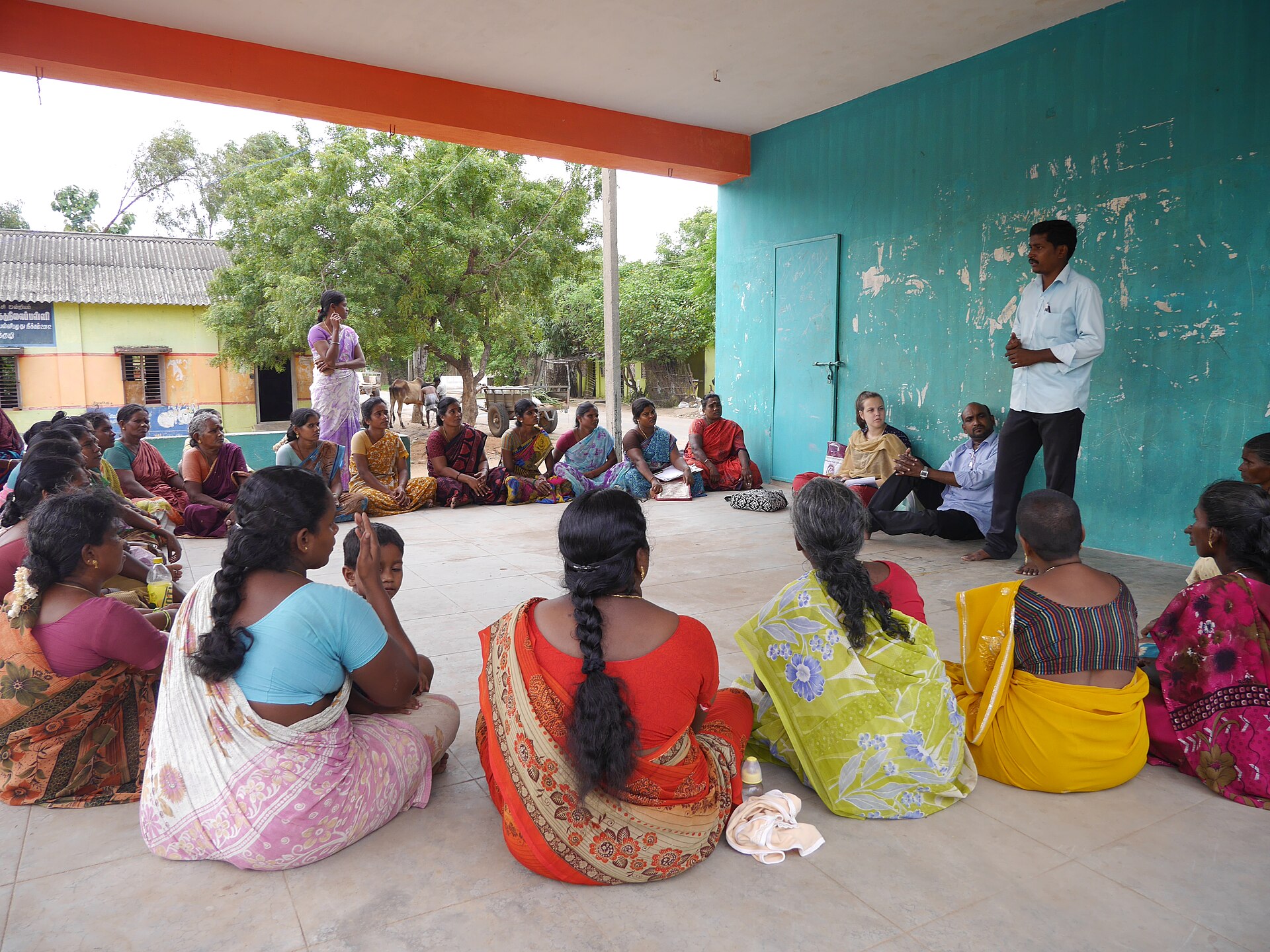
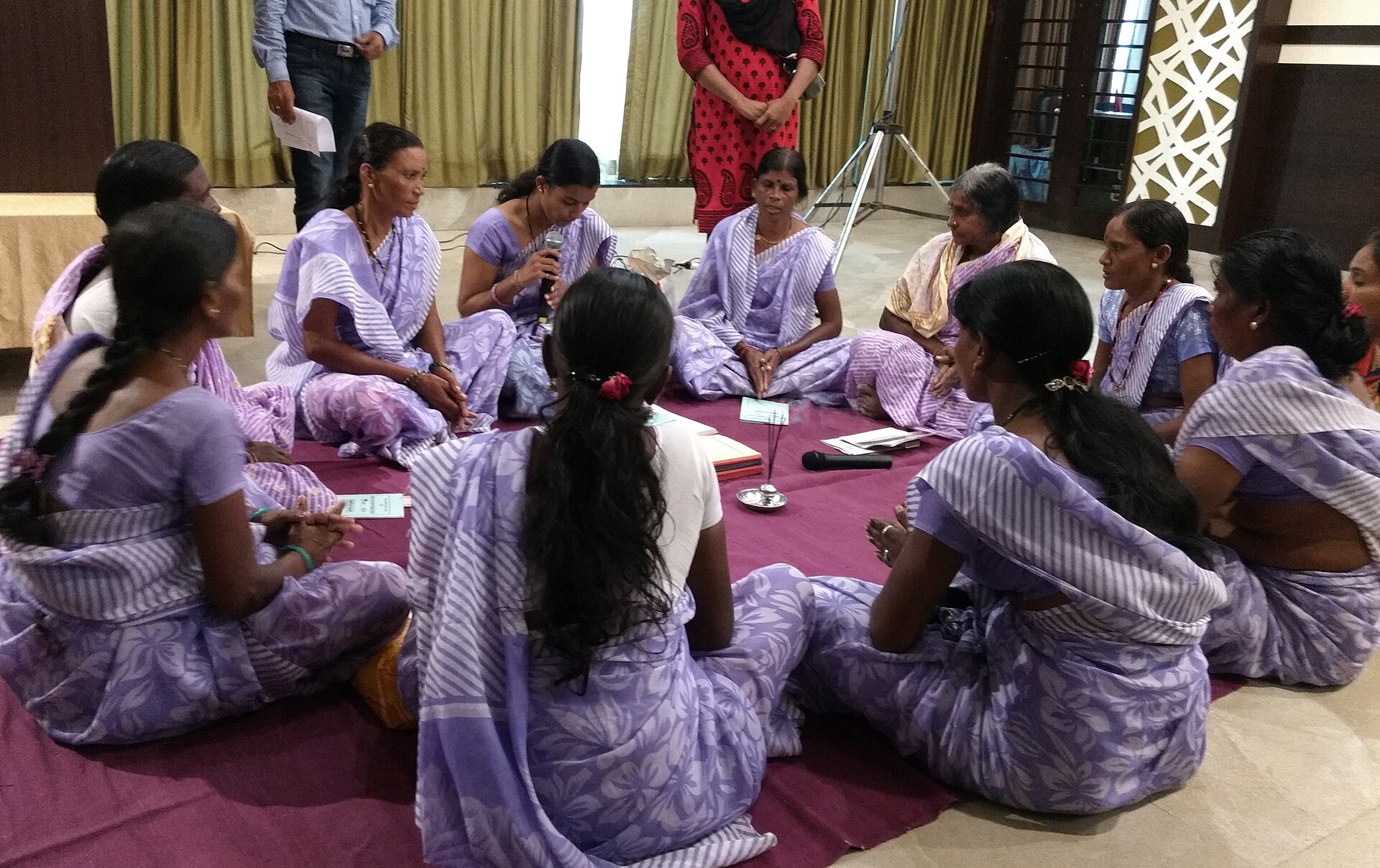
Once a week, in a village hall or under a tree, ten to twenty women sit in a circle. Each puts a small sum into a common pot, and one of them writes it down in a notebook. Then someone asks to borrow from the pot for a sewing machine or a child’s school fees, and the group decides together. Nothing about this looks grand. Yet women’s self-help groups (SHGs) have grown into one of the largest community networks in the world, and their effects reach well beyond the women sitting in the circle.
This is the third article in Samridhi Foundation’s 20-part series on grassroots empowerment, education and social welfare. In the last one we looked at digital literacy for young people. Here we look at what happens when women organise around their own savings, and why the benefits spread to families and villages.
What a self-help group is
An SHG is a voluntary group, usually of 10 to 20 members from similar backgrounds. Members save a fixed amount at regular meetings, lend to each other from the pooled money at rates they agree among themselves, and keep their own records. Once a group has saved and repaid on time for a few months, a bank can lend to it as a group. NABARD began linking SHGs to banks in 1992, and the model has since spread to nearly every state.
The numbers are large. NABARD’s data shows that, as of 31 March 2024, about 1.44 crore SHGs held savings accounts with banks, and about 1.2 crore of them were groups made up only of women. Separately, the government’s Deendayal Antyodaya Yojana-National Rural Livelihoods Mission (DAY-NRLM) reports that it has brought 10.05 crore rural households into 90.90 lakh SHGs across 28 states and six Union Territories. The two sets of figures differ because NABARD counts every bank-linked group, while the mission counts the groups it has promoted.
Where the ripple starts: money
Savings and credit close to home
For many rural women, the only source of an emergency loan used to be a moneylender. A group changes that. A member who needs money for a hospital bill borrows from her own group’s savings, at a rate the group has set, and repays to people she knows. A World Bank review of evidence from South Asia, published in 2023, noted that an evaluation of an SHG credit programme in rural India found members relied less on high-interest credit from informal moneylenders.
From small loans to small businesses
Over time, loans move from emergencies to enterprise: a second buffalo, a tailoring unit, a roadside food stall, a small shop. The mission’s Lakhpati Didi initiative aims to help SHG members reach a household income of at least ₹1 lakh a year. In 2025 the government told Parliament that more than 1.48 crore members had already done so. By the mission’s own account, 4.62 crore SHG members are engaged as Mahila Kisans, working in farming and allied activities.
Beyond income
A reason to meet, and a voice when they do
For many women, the weekly meeting is the first regular gathering outside the home that belongs to them. They learn to keep accounts, speak in a group, disagree and settle the matter. Groups join up into village organisations and then cluster-level federations, which gives them a collective voice when they deal with banks, panchayats and government departments.
New roles in the community
SHG members often become the local face of financial services. Under the mission, 47,952 Bank Sakhis have been placed in bank branches to help with credit linkage for groups. Others work as community trainers, health volunteers or bank correspondents. These are paid or recognised roles, and they change how a woman is seen in her village.
Where groups struggle
Not every group thrives, and an honest account has to say so. Groups formed quickly to meet a target often stop meeting once the field worker leaves. Record-keeping can be weak, and one member who does all the writing creates a risk for the whole group. Women who carry most of the household work find it hard to give time to meetings and enterprise. Products made by SHGs can be hard to sell beyond the local market, and some groups depend on subsidies that eventually end.
The pandemic showed how fragile momentum can be. New SHGs formed under the mission fell from 9.77 lakh in 2019-20 to 6.02 lakh in 2020-21 before recovering.
What helps groups last
Practitioners keep returning to a few points.
- Long handholding. NABARD itself extended the support period for new SHG projects to four years, because groups need more than a quick start.
- Training in bookkeeping, loan appraisal and rotating the role of group leader, so that skills are shared.
- Market links for what members produce, including training in pricing, packaging and online selling.
- Safe use of digital payments and mobile banking, with fraud awareness built in. This builds directly on the digital literacy work described in our previous article.
- Meeting times and places that suit women’s working days, and the support of husbands and in-laws, which is often won through patient conversation.
How donors, CSR partners and volunteers can help
- Fund the first three to four years of mentoring, not only start-up grants.
- Pay for local women trainers and community resource persons, who stay in the village after the project ends.
- Support market access: stalls, packaging, quality checks and links to buyers.
- Offer skilled volunteering such as accounting basics, legal awareness, nutrition or digital skills sessions.
- Ask groups what they need before designing a programme around them.
The bigger picture
A self-help group costs very little to start and asks nothing of its members except regular attendance and honesty. What it builds is harder to count: trust between neighbours, a habit of saving, and women who are used to making decisions in public. These are the foundations on which later gains in health, schooling and enterprise are built. That is why we treat the women’s group as a starting point for community development rather than a side activity.
Key Takeaways for Social Impact
- An SHG is a group of 10 to 20 members who save together, lend to each other and keep their own accounts, with access to bank credit once the group is established.
- Official figures show 10.05 crore rural households in 90.90 lakh SHGs under DAY-NRLM, and about 1.2 crore women-only groups with bank savings accounts, according to NABARD data for March 2024.
- Benefits start with cheaper, closer credit and grow into enterprise, new roles and a collective voice.
- Groups fail when they are formed in a hurry, depend on one leader or have no market for their products.
- Long-term mentoring, local women trainers, market links and safe digital banking help groups last.
- Donors and CSR partners add the most value by funding the years after formation, not only the launch.
Would you like to support women’s groups in your area, as a volunteer, a trainer or a funding partner? Get in touch with Samridhi Foundation to find out how. Next in this series: holistic child development, with nutritious food, education and safe spaces for every child.